
By Steven Eddie, ECV Nutritionist
With many farmers reporting reduced silage stocks as a result of the dry weather experienced throughout the summer, feeding straw to supplement grass silage is something to consider when planning feed strategies for the winter ahead. This is even more important in the case of dry cow diets and beef cattle on intensive finishing systems. Whilst the dry summer has not aided grass growth, the conditions have suited cereal crops with the majority being cut in good order. Reports of high yields and good quality grain seem to run across the board with the majority being cut drier than normal. This has been a much-welcomed bonus when current fuel costs are taken into consideration. As well as high quality grain, the dry weather has also ensured that straw has been baled in good condition which provides a further feed source for the winter as well as high quality bedding.
Despite being relatively unpalatable, indigestible and low in protein, straw is an excellent base for ruminant diets. It is an effective source of long fibre and there are a number of ways of improving both animal intakes and their utilisation of straw making it an ideal substitute for a proportion of silage. The feeding quality of straw can be improved by either treating it chemically or by supplementing other feeds alongside it. Suitable feeds to accompany straw must promote vigorous rumen fermentation. This maximises the rate of microbial growth in the rumen and makes full use of the digestible fraction of the straw itself. The two critical components of supplementary feeds are a good source of fermentable metabolisable energy (FME) paired with a compatible supply of effective rumen degradable protein (ERDP).
The addition of straw to the diet of pregnant suckler cows will enable silage supplies to be stretched whilst also maintaining cow body condition. For example, 10kg of grass silage can be substituted for 2.1kg of straw and 1kg of Regumix Molasses. This allows silage to be saved and fed to higher priority stock such as growing cattle and lactating cows. Where significant levels of straw are included in the ration, feeding a molasses blend will help improve palatability and ensure intake of the straw portion of the diet. Up to half of the silage requirements can be replaced with a molasses blend and straw. The high palatability of molasses makes it an ideal supplement to lower quality forages such as straw, hay and poorer quality silage by increasing intakes and enhancing their nutritive value.
East Coast Viners Animal Nutrition, in partnership with molasses supplier ED&F Man, can tailor your feed plan to improve animal performance whilst reducing costs. Including a molasses blend in your total mixed ration improves palatability, reduces dust and increases intake. Within their product range, ED&F Man can supply molasses blends that have added protein to balance rations containing high inclusions of home-grown cereals and straw to produce a complete diet for finishing cattle and suckler cows.
Feed costs are one of the main factors affecting the overall profitability on beef units. Over the last year, the price of bought-in proteins has risen greatly. Raw materials like Hi pro Soya have seen large price increases which then cause a knock-on effect to other protein products. Rising energy costs have also increased the price of Feed Grade Urea which is a popular protein source in finishing rations and features heavily in the production of alkaline treatments for moist grain. Raw materials such as Distillers Dark Grains and Pot Ale Syrup which have made up large proportions of cattle rations in the past have become difficult to acquire and supply is not guaranteed due to competition from other sectors. Recent market increases combined with unfavourable exchange rates have also seen molasses increase in price but it still remains good value and earns a place in livestock rations.
Molasses blends complement a total mixed ration by supplying energy and protein to the diet itself whilst binding the TMR and distributing nutrients evenly to ensure safe and uniform intake by animals. By working with ED&F Man, we are able to offer high quality molasses blends that provide flexible energy and protein levels to meet each farm’s needs.
By utilising the ruminant’s natural ability to produce microbial protein, this can allow for more cost-effective production. Microbial protein is the most economic source of protein for ruminants with its high digestibility value and optimal amino acid profile. It is used in the synthesis of milk protein, muscle structure and various other enzymes and hormones. To optimise animal production, whether for milk yield or live weight gain, it is important to correctly supply protein both in terms of rumen degradable and undegradable protein. Around 70% of the protein consumed by ruminants is broken down into ammonia which is used to produce the microbial protein.
In order to produce microbial protein, the rumen also requires a source of fermentable metabolisable energy. The inclusion of a molasses blend to the ration improves rumen function. This increase in activity is mainly due to sucrose present in the sugar in the molasses. Sucrose is a six-carbon sugar that has a significant effect on fibre digestion and production of microbial protein. Sucrose fermentation also aids butyrate production which stabilises acid loading in the rumen which in turn reduces the risk of acidosis.
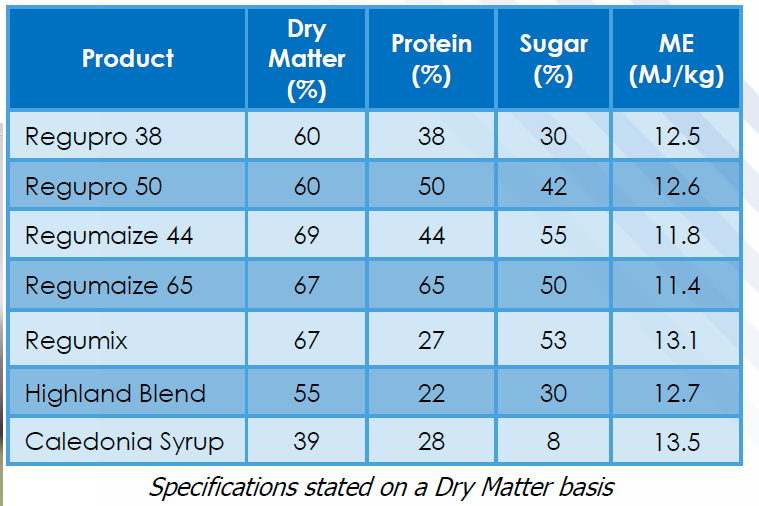
The ED&F Man range of Regulated Release Molasses Blends such as Regupro and Regumaize supply an ideal combination of readily available energy and both natural and regulated release proteins. Regulated Release is a unique patented process developed by ED&F Man Liquid Products and is designed to give rumen bacteria exactly what they need to thrive. By providing a balanced and synchronised supply of energy and protein, this leads to increased microbial protein production and better animal performance. With a higher yield of microbial protein, less extra protein in the form of soya or bypass protein need to be fed. This maximises rumen performance resulting in a more cost-effective ration.
Research carried out at the University of Reading investigated the effect of replacing 1.6kg of a soya and rapemeal blend with 2kg of Regumaize 44 within a TMR. The results found a significant increase in milk protein (+0.09g/kg) and an increase in milk fat (+1.5g/kg) whilst feed intake was maintained
Regulated Release products can also be used as an alternative to Pot Ale Syrup. While pot ale can be a cost-effective liquid protein, cost and supply fluctuate throughout the year. Nutritionally, it varies in analysis depending on the process at each distillery. Dry matter contents vary from 35-45% and protein can range from 10-14% crude protein as fed. Pot Ale Syrup also has a low sugar content so does not provide the same rumen stimulation. Regupro products have a much higher dry matter content. This means that 0.83kg of Regupro 50 will replace the protein found in 2kg of Pot Ale. Each product in the Regulated Release range is blended to a formulation. This ensures that each load is consistent in analysis and physical quality.
ED&F Man also offer a range of lower dry matter blends that utilise distillery co-products and food industry syrups that can be used as replacers for Pot Ale Syrup. These are ideally suited for use in beef diets where the ration requires de-dusting or when the palatability needs improved. The lower viscosity allows for good absorption within a mix or when poured over forage. Highland Blend and Caledonia Syrup both offer a good source of energy and protein making these blends an ideal addition to cereal diets.
ED&F MAN PRODUCT RANGE
SUITABLE FOR MIXING WITH HOME-GROWN
CEREALS AND STRAW
WHEN TO FEED
Regupro 38 and 50: Ideal supplement to rations containing lower protein ingredients and home-grown cereals. Helps to complement rations based on grass silage by correcting energy and degradable protein imbalances. (Dairy & Beef)
Regumaize 44 and 65: Targeted to get the most from maize, wholecrop silage and straw. Regumaize blends have a high nutrient density meaning that high levels of animal performance can be supported. (Dairy & Beef)
Regumix:Designed to complement grass, mixed forage diets and straw based rations. Ideal for balancing buffer feeds for grazing animals. (Dairy, Beef & Sheep)
Highland Blend and Caledonia Syrup: Both provide energy and protein in the form of a lower viscosity product ideally suited for use in cereal beef diets where the ration requires de-dusting or when the palatability needs improved. (Beef)